

Make your voice heard
"Being a delegate means choosing to help" - Laurent Tresch’s commitment to the employees of Luxembourg.
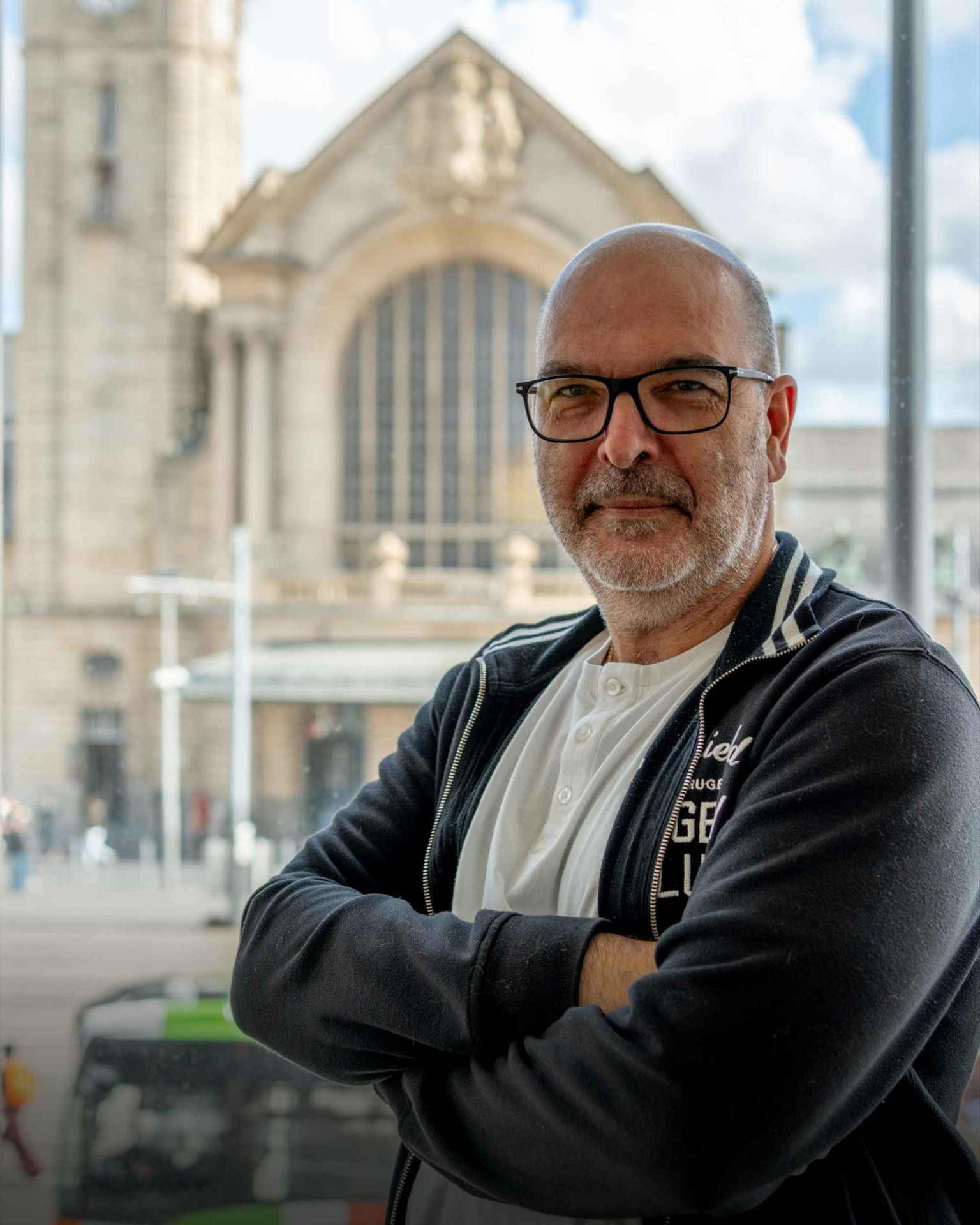
Listening to Laurent Tresch talk about his journey as a delegate is like listening to one of the most influential voices at ING Luxembourg, even though nothing predestined him for it.
“I started in 1994 at Société Générale. I stayed there for four years, then I joined the Industrial Bank of Japan, as it was called at the time.” Laurent Tresch’s tone is almost nostalgic. In 2000, he changed direction once again and joined ING, which at that time had nothing of the giant it is today: “There were around 200 of us. A small structure, very human.”
Twenty-five years later, Laurent is still part of the company. And his connection with ALEBA also dates back to his very first steps into the working world:
“I became a member of ALEBA as soon as I entered professional life.”
Yet nothing was written in advance: “Even before being elected, I was asking questions, sending my thoughts to the president of the delegation. Then one day, he suggested that I join the list.” It was the desire to help that pushed him to commit.
“I understood that I could really do something for people.”
The first mandates are those of learning: substitute delegate, then full delegate. At that moment, he discovered a dimension that would transform his entire career: supporting employees with disabilities. “I was an equality delegate, freed up for 20% of my time. That allowed me to take care of people with physical or mental disabilities. I understood that I could do a lot. Helping people is what drives me.”
Under his initiative and that of his team, ING Luxembourg facilitated access to buildings, adapted workstations, recruited employees with diverse profiles — and above all, opened mindsets. “We had time, we adapted tasks. At the time, ING had real social value. The company has always been ahead on these issues.”
Local engagement was only the beginning. Strengthened by his experience, Laurent then joined ALEBA’s Administrative Committee, and later its Executive Committee, where he first held the role of head of human resources for the union, before becoming head of training.
“When you work in a company, you see a lot. But when you enter the union world, you see even more: more questions, more choices, more responsibilities. It’s fascinating.”
He also brings essential expertise: collective bargaining. “I have negotiated four collective agreements over the course of my career. And with the new social dialogue, it is even more strategic.”
Social progress does not fall from the sky. It is built, sometimes millimetre by millimetre. Among the noteworthy achievements:
- The increase in the value of meal vouchers;
- The implementation of flexible working hours;
- The recovery of overtime hours;
- The introduction of a transport allowance;
- Revision of the POT (Work Organisation Plan);
- An Age-Friendly Plan for employees over 50.
But the commitment of a delegate is not measured only by visible victories. Sometimes, it is about supporting employees, as in the social plan imposed by the bank. It is then necessary to find the right compromises that will allow the employees concerned to benefit from the best possible conditions while ensuring them access to training with a more than adequate budget for their retraining.
That is the ALEBA method: being at the side of employees during difficult moments and finding solutions that put the human being at the centre of the discussions.
He also shares those small stories that no one sees, but that change a life: “I helped a trainee find housing. We helped him obtain a lease. It may be a detail for some, but for him, it was huge.”
When asked what has marked him the most, he does not talk about negotiations or legal texts. He talks about the employees.
“The best thing is being re-elected with a lot of votes. That means your work is recognised. It is a real joy.”
He nevertheless points out a truth known to every delegate: union engagement is far from being a sinecure, and one must learn to build a protective shell:
“You must enter the delegation to do something, not to hide behind a mandate. Sometimes, you do not make your management happy. You defend the employees, they defend the company. We have opposing views. You must accept this role.”
“When you become a delegate for the first time, you need a period of observation. You must train yourself. You must always check what is available and never hesitate to train. Read, stay informed about new laws, follow current events… The job changes, the world changes. You must evolve with it.”
He insists on one essential point:
“Within ALEBA, we are lucky to have high-quality training to support every delegate.”
He adds three crucial qualities: empathy, neutrality, and understanding of the social and family context of each situation. “Every person has a story. You must listen to it.”
“Without unions, employees lose their rights.”
For Laurent, the existence of ALEBA is more than necessary: it is fundamental. “The union is like insurance to preserve the well-being of employees.”
Twenty-five years spent in the same company, four mandates, unanimous recognition. Laurent’s story is not only that of a delegate, but that of a man who chose to serve others, discreetly, day after day.
It is also the story of ALEBA, an association of men and women who believe that social progress is a work of teamwork, field experience, and conviction. In a working world that is changing ever faster, their voice remains essential. And as long as it is carried by people like Laurent, it will remain strong.
News
ALEBA meets with employees
Learn more
Financial aid for higher education: new rules from the 2026/2027 academic year
Learn more
ALEBA’s Success: A significant improvement for cross-border workers regarding Luxembourg tax declaration
Learn more
A great victory for an ALEBA member!
Learn more
ALEBA Calendar 2027
Learn more
Taxx.lu and ALEBA are now partners
Learn more